Explains what Deskrawl is, how the desktop idle loop works and what you actually do minute to minute.
Deskrawl Idle ARPG: What It Is and How It Plays
Deskrawl Idle ARPG is a desktop idle action RPG for Windows that lives in a strip along the bottom of your screen while you work. Your hero fights, loots, and levels on its own; you step in for gear choices, zone pushes, minion captures, and town upgrades. It launched on Steam on September 28, 2026, made by First Day Games.
Four things explain the whole game:
- It plays while you do something else. Combat is automatic, so the game runs beside your work instead of demanding your screen.
- You are the quartermaster, not the sword arm. Gear, talents, minions, and zones are your decisions; swinging the weapon is not.
- Loot chases you, then buries you. Drops pile up fast, so filters, auto-sell, and carriage space matter more than raw damage early.
- The campaign is a long single line. Seventy maps run from level 1 to level 70 with no forks, so progress always means pushing the next map.
The Desktop Strip: What Idle Means Here
Most idle games are a window you maximize. Deskrawl is a companion that sits at the bottom of your desktop while you browse, code, or watch videos. Your hero walks, fights mobs, picks up loot, and gains experience without clicks from you. Enemies in Deskrawl drop loot on a normal schedule, bosses guard the end of each region, and your carriage hauls everything back to town.
Official source: Deskrawl: Idle ARPG on Steam — "Grind mobs, farm loot, and capture enemies to serve you. Deskrawl is an epic idle ARPG that plays at the bottom of your desktop. Farm legendary items and build overpowered heroes while you work or chill."
The honest version of "extremely idle" has one catch that every new player meets on day one: the hero fights on its own but does not walk itself into the next zone. Moving between maps, managing gear in town, and capturing minions stay manual. So the rhythm is bursts of management separated by long stretches where you glance down, watch a boss fall, and go back to work. The developers describe it the same way on the Steam forums, and our offline earnings guide draws the exact line between what the game automates and what it never will.
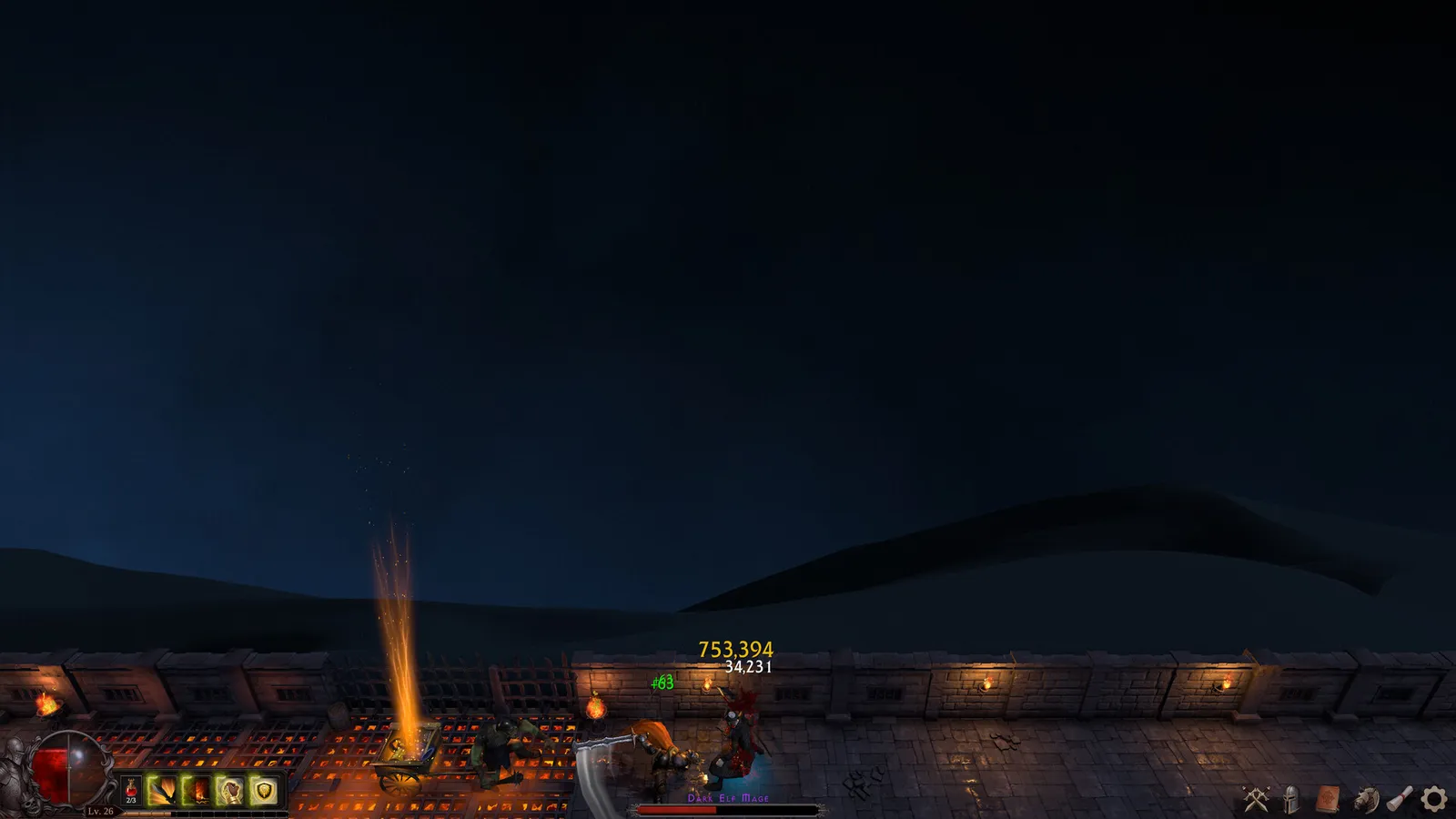
Deskrawl is Windows only, single-player, with Steam Achievements, Steam Cloud, leaderboards, and Family Sharing. It ships in 13 interface languages and asks for modest hardware: a Core i3 with 4 GB of RAM at minimum. Full specs and the platform situation are on our release date and system requirements page.
What You Actually Do Minute to Minute
A typical session looks nothing like a normal ARPG session. You open the game, spend five to ten minutes managing, then ignore it for an hour. The management checklist barely changes from week one to month three:
- Empty the carriage. Loot collected while you were away or idle waits in the cart. Sell what is weak, keep what upgrades a slot, and salvage the rest once you unlock that action.
- Push upgrades that are free. Gear upgrades from +1 to +4 always succeed, so everything you wear should sit at +4 before you spend anything on risky rolls. The full odds table is on our equipment upgrade page.
- Check the next zone. If your hero cleared the current map, walk it forward yourself. The campaign never branches, so a stuck hero is almost always a hero standing in a finished zone. The full order is on our areas and levels guide.
- Spend talent points. Points arrive with levels and cost nothing to place, since no talent locks any other talent out. Only capstone picks are exclusive, one per layer. Details are on our talents guide.
- Capture what dropped. Minion unlock items appear as loot, and spending one unlocks that enemy as a permanent companion. Bosses can be captured too, which makes every region finale a recruitment run as well as a gear check.
That is the loop: manage for minutes, idle for hours, come back to a fuller cart. If your cart keeps filling with gear you will never wear, the beginner guide first-hour order shows which automation to buy so the junk sells itself before it eats your space.
Difficulties can only be switched inside town, vendors and stash live there, and returning to town heals you for free once you own the tree root. Make town your only management screen and the loop stays clean: field time is idle time, town time is decision time.
Combat, Loot, and Gear in One Loop
Combat needs no input, but gear needs constant judgement. The 1.0 build ships 219 equipment pieces across eleven slots, and rarity runs Common, Uncommon, Rare, Legendary, and Divine, followed by rune sets. There is no Epic tier despite what some guides claim. Legendary drops start at level 10, which is why the first ten levels feel slow and everything after feels like a slot machine that finally takes your coins.
The numbers that shape every gear decision:
| System | Rule | What it means for you |
|---|---|---|
| Upgrade odds | +1 to +4 always succeed, then 75% / 50% / 40% / 30% / 20% / 10% down to +10 | Take every worn item to +4 free, gamble only on keepers |
| Gem sockets | Unlock at item level 30, six of eleven slots can hold them | Ignore sockets entirely in your first week |
| Runes | Start dropping at level 40 | A level-40 power spike to plan around, not chase early |
| Divine gear | Third difficulty only | Endgame loot you cannot touch until you clear the final boss twice |
Four classes share almost all of this gear: Warrior, Sorcerer, Hunter, and Monk. One hundred thirty-five of the 219 pieces fit every class, and the weapon slot is the only place where class identity bites hard. The Hunter equips bows only, from a pool less than half the size of the next smallest, while the other three split maces, swords, axes, and staves between them. Class choice is permanent to that character, so read our class builds comparison before you commit, not after.
Abilities unlock at levels 1, 5, 10, and 15 across four slots, shared in structure by all four classes. Combined with 185 talents that have zero prerequisites between them, the build game is wide rather than deep: many small choices, almost none of them irreversible. A regretted capstone costs 8 gold to swap, which is less than a potion.
Minions, the Carriage, and Town Progression
The signature system is capture. Enemies in Deskrawl can be captured, including bosses, by spending a loot item called a Rein on each one. Captured minions haul the loot cart so grinding never pauses for inventory trips, and they fight beside you: some grant passive buffs while a smaller set fires active abilities in combat. The launch build contains 67 minions, 23 of them Legendary, and every one of the 20 bosses is among those Legendaries.
Carriage capacity is the quiet stat that rules this system. It runs from 15 to 35, a typical minion sits near 25, and only Legendary minions reach the top of the band. Since only 15 of the 67 minions carry an active ability, most captures are capacity and passive buffs rather than new combat tricks. The full breakdown, including which cheap mounts punch above their price, is on our minions and carriage page.
Town grows alongside the cart. Stockpiled resources turn a quiet outpost into a hub, and each unlocked NPC or service opens another way to convert loot into power: vendors, stash pages, crafting-adjacent services, and the difficulty switch. Town progression is why gold always has somewhere to go, even when your gear is settled. If you want the exact purchase order that wastes nothing, the beginner guide prices the first eight life skill nodes down to the gold.
Trading exists as a Steam Market feature for equipment, materials, and minions, but treat it as a bonus rather than a plan. At launch it barely functioned, and the game is fully playable without ever touching it.
Zones, Difficulties, and the Long Climb
The campaign is one unbranching chain of 70 maps across 11 regions, from Kings Woods at levels 1 to 10 up to The Cinder Crown at levels 65 to 70. Every map requires exactly the previous one cleared, and region finales ask for a Demon Skull key on top. Enemy levels run 1 to 70 without gaps, which is why grinding an old zone past its band buys nothing: the gate is the map, not your level. Our Demon Skull entry guide covers the key rules, and the final boss guide covers the last door.
Above the campaign sit three difficulties. Clearing the final boss unlocks the next tier, from Normal through Nightmare to Inferno, with better rewards each step. Divine gear and set runes live on Inferno alone. Past the level 70 cap, paragon levels take over starting at 25,000 mobs for the first one. What each tier changes in practice is on our difficulties and Inferno guide.
Scale expectations with achievement data: about four in five counted accounts own a Legendary, roughly one in ten has equipped a rune, and about one in two hundred has hit level 70. The designers built a game most players experience as a loot chase with an ending almost nobody sees. That is not a flaw in an idle game, but it is the truth about the back half.
Offline Earnings and the 8-Hour Cap
Close the game and your character keeps hunting. One absence credits at most 8 hours, banked against your highest unlocked area rather than wherever you stood when you logged out. The offline kill rate follows your level on a fixed curve, roughly 70 mobs an hour at level 5 rising to 690 an hour past level 60, with a long flat stretch between levels 20 and 40 where twenty levels of growth buy zero extra mobs per hour.
Three life skill nodes on one branch raise the cap from 8 hours to 16, adding 2, 2, and 4 hours for a total branch cost above 100,000 gold. Switching the feature on at all costs one cheap node, Expedition Camp at 750 gold. Offline pays gold and experience only: no gear drops while you are away, no matter how long the absence. The kill tables, the per-absence math, and the open questions about difficulty scaling are all worked through on our offline rewards page.
The cap is per absence, not per day. Logging in every few hours banks the full cap each time; sleeping twelve hours banks eight and throws the rest away. Buy the cap nodes before you plan your life around overnight sessions, and check the reward panel fraction every time: the number on the right is your live ceiling.
Who It Fits and What It Costs
Deskrawl launched at a list price of $6.99 with a 30% launch discount, placing it firmly in impulse-buy territory. English Steam reviews sit at Very Positive while the all-language aggregate reads lower, dragged down by a large Mixed-rating cohort in other languages. Our worth-it verdict reads all 771 launch-week reviews and all 37 achievement rates to give a buy-or-wait answer with a date on it.
Buy it if you want a game that runs in a corner of your screen while you work, you enjoy loot chases more than endings, and four classes with capture-anything minions sounds like your kind of collection game. Skip it for now if you need a working player marketplace, a difficulty curve tuned for veterans, or a campaign you will actually finish: the last zone is opened by under 2% of counted accounts.
Useful next steps live on this site: the beginner guide for the first hour, offline earnings for the AFK math, minions and carriage for captures, and patch notes to check what changed since this page was written.
Official source: patch history and announcements ship through the Deskrawl Steam news hub, and player help threads live on the Deskrawl Steam discussions. Gameplay footage from the developers is on the official Deskrawl YouTube channel.
FAQ
Is Deskrawl really idle, or does it need constant clicks? Combat, looting, and levelling are automatic, and offline hunting banks up to 8 hours while the game is closed. What stays manual is moving between maps, managing gear in town, and capturing minions. Nobody auto-advances stages for you.
What do I actually do while the game runs? Short management bursts: empty the carriage, take worn gear to +4, push the next map, spend talent points, and capture new minions. Then leave it alone. Five to ten minutes of decisions buys hours of idle progress.
Which class should a new player pick? Any of the four works for the campaign, since 135 of 219 gear pieces fit all classes and no talent locks another out. The one mechanical warning is the Hunter: bows only, from the smallest weapon pool by far. Class choice is permanent per character, so check the comparison page first.
Does Deskrawl end, and how long does it take? The campaign ends at a final boss past 70 maps, with Nightmare and Inferno tiers plus paragon levels after that. Almost nobody finishes: about 1% of counted accounts have beaten the final boss and about 0.5% have hit the level 70 cap. Our how-long-to-beat page breaks the length down further.
Can I play it on Steam Deck or Mac? Deskrawl is Windows only with no Mac, Linux, or console version, and Deck support is officially undeclared. Minimum specs are a Core i3 with 4 GB of RAM and 5 GB of disk. Check the requirements page before buying for a non-Windows machine.
Related Guides
- Deskrawl Beginner Guide: What to Unlock in Your First Hour — the exact purchase order that makes the idle loop run itself.
- Deskrawl Offline Rewards: The 8-Hour Cap Explained — kill-rate tables and cap math for planning absences.
- Deskrawl Minion and Carriage Capacity: 23 Legendary — which captures matter and why capacity beats rarity early.
- Deskrawl Zones and Level Order: The 70-Map Chain — every region and level band so you always know the next map.
- Is Deskrawl Worth It? Price, Reviews and a Verdict — launch pricing and review splits if you have not bought yet.
More Deskrawl: Idle ARPG Guides
Deskrawl class builds compared without a tier list: talent counts, weapon pools, socket limits and the exact gold each class should spend first.
The 1.0 release raised the cap from 35 to 70, expanded the talent tree, reworked Life Skills and added a Paragon tab. Demo saves are wiped.
Demon Skulls are the only entry currency, and the rule is odd: entry only checks your balance, and the skull is deducted after you clear the stage.
Deskrawl has exactly three difficulties. Inferno multiplies enemy HP sixfold and is the only tier that drops Divine gear, rune sets and Mythic content.
The real Deskrawl loot table from the 1.0 build — 87-95% no-drop rolls on trash mobs, chest contents, and what patch 1.0.0g actually changed.
The verified Deskrawl +10 upgrade table: four guaranteed levels, then 75%, 50%, 40%, 30%, 20% and 10% — plus the material each slot needs.
Locates the final boss, lists entry needs and gives a clear plan to beat him without wasted runs.
All three Deskrawl fishing lakes, all 12 catches in each, the 50 percent empty rate, and the one Rein that only comes out of water.