There is no gold map in Deskrawl. Gold comes from offline mob rolls scaled by difficulty bonus, Life Skills gold find, and the lucky wheel.
Deskrawl Gold Farming: Five Inputs, No Gold Map
Deskrawl has no gold map, no gold-only zone and no gold enemy. Gold arrives through five inputs, and only one grows on its own: offline kills. The other four are multipliers, flat rewards or conversion rates. The fastest early route costs 1,700 gold from zero and involves no farming at all.
Most Deskrawl gold guides point you at a special farming zone. There is no such zone — all 76 areas pay the same base rate plus the difficulty bonus for the level you have cleared. What separates a rich player from a broke one is not where they stand, it is which of the five inputs below they have actually turned on.
Read from the game's own shipped data, 1.0 launch build (28 September 2026). The game has since moved to patch 1.0.0g, so a number may have moved by one patch. Where the game has never published a number, this page says so instead of guessing.
| # | Gold input | The number behind it | What it does |
|---|---|---|---|
| 1 | Offline mob rolls | 4 mobs per gold roll | The only input that scales by itself |
| 2 | Difficulty bonus | +0.5% / +1% per map level on Nightmare / Inferno | Adds a flat percentage on top of everything you pick up |
| 3 | Gold Find | 12 of the 85 life skill nodes, plus the Gold Find affix | Multiplies incoming gold |
| 4 | Selling loot | 501 of 510 items carry a vendor price | Flat conversion, up to 500,000 per rein |
| 5 | The Lucky Wheel | 5,000 per spin | A materials sink, not a gold engine |
So: four of these five are levers you pull once or twice. Only offline kills keep paying while the game is closed — so unlock that first, then stack the multipliers on top of it.
Offline kills are the trunk, and you must unlock them
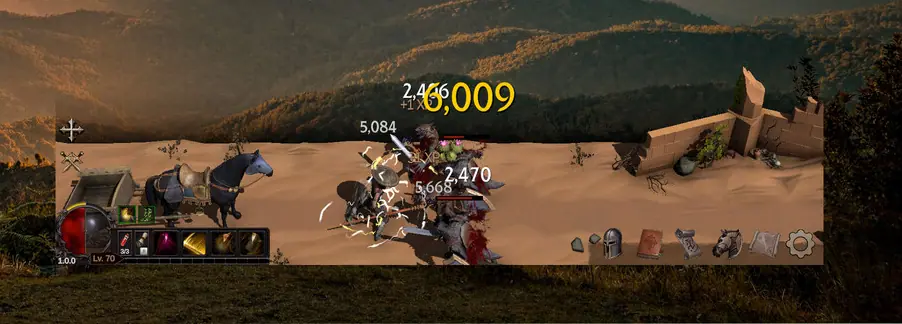
One gold roll is worth 4 mobs, and a separate curve decides how many mobs you get per hour at your level. Those two numbers are the whole offline economy:
| Character level | Offline kills per hour | Base gold rolls per hour (kills ÷ 4) |
|---|---|---|
| 5 | 70 | 17.5 |
| 20 | 470 | 117.5 |
| 40 | 470 | 117.5 |
| 60 | 690 | 172.5 |
So: the curve is flat between level 20 and level 40 — twenty levels buy you no extra offline throughput at all, which is why mid-game players feel stuck. The game also states that gold accrues "based on the highest area you have unlocked", not the zone your character is standing in. Clearing a new zone is the largest offline gold upgrade available to you.
The catch is the unlock. Offline rewards are a Life Skill, not a default. Expedition Camp sits behind XP Gain I, which sits behind the single root node at the bottom of the tree — the one node that needs nothing bought before it. All three together cost 50 + 150 + 750 = 950 gold from zero in the 1.0 launch build. Before that purchase you earn no offline gold at all, however long you are away.
Buy the root (50), then Gold Find I (150), then Equipment Auto-Sell (1,500) — Auto-Sell's only requirement is Gold Find I, and skipping the root leaves both of them locked. That 1,700 buys a permanent multiplier and a passive vendor running at the same time, for a third of one wheel spin.
So: 1,700 gold is the price of your entire early game. Every farm on this page is downstream of those three purchases, and every one of them is wasted if you buy Auto-Sell before Gold Find I.
The base offline cap is 8 hours. Two nodes add 2 hours each and one adds 4, which would total 16 — but the game never states a total and no developer has confirmed one. Treat 8 as confirmed and anything above it as a target, not a promise. The offline earnings guide covers the cap in full.
Difficulty is why endgame players hold more gold
There are three world difficulties, and two of them pay a gold bonus for every map level you have cleared.
| World difficulty | Enemy health | Experience | Bonus gold per map level | Boss material drops |
|---|---|---|---|---|
| Normal | 1× | 1× | 0 | 1× |
| Nightmare | 3.5× | 1.5× | 0.5% | 1.5× |
| Inferno | 6× | 2× | 1% | 2× |
Multiply that by your map level and the common observation makes sense — late-game players are richer farming the same zones:
| Map level | Nightmare | Inferno |
|---|---|---|
| 1 | +0.5% | +1% |
| 20 | +10% | +20% |
| 40 | +20% | +40% |
| 60 | +30% | +60% |
| 70 | +35% | +70% |
So the bonus tracks how deep you have pushed, not how hard the current zone is. On top of it, an ordinary enemy drops gold 30% of the time, while elites and every boss tier drop it 100% of the time, and the payout multiplier on a gold drop climbs from 2× to 5×. No meter on screen shows any of this — it is the arithmetic running behind the payout, not a number you can watch.
Inferno multiplies enemy health by 6 to pay +1% gold per map level. If you cannot survive the zone, the bonus is unreachable — and because it is per map level, a level 20 zone on Inferno pays a fifth of what the same difficulty pays at level 70. Push the zone first, then the difficulty. The difficulty guide covers survivability.
Gold Find: the two numbers behind the multiplier
Gold Find I and Gold Find II are the only two life skill values in the game that pay out as a gold multiplier, and both are listed in the tree as a rounded whole percent — which is why the node panel reads +10% and +42% while the real figures carry more precision than that.
| Node | Exact value | What it does |
|---|---|---|
| Gold Find I | 0.102941133081913 | +10.29% gold find |
| Gold Find II | 0.4225509762763977 | +42.26% gold find |
So: buy these for the multiplier, not for the tooltip. Of the 192 in-game modifiers the game formats as a whole percent, 179 land in the 0–1 range that reads safely as a percentage bonus — Gold Find I and II are both in that group, so the +10.29% and +42.26% above are what actually reaches your wallet.
Twelve of the 85 life skill nodes carry one of these two effects — six Gold Find I, six Gold Find II. Whether they add together or overwrite each other, the game never tells you, and neither does anyone else. Treat the sum as the optimistic case and read the tree in-game before committing 150 gold a node. The life skills guide maps where each node sits.
The gear side is narrower. Gold Find appears in the secondary stat pool of exactly six slots — Helm, Chest, Pants, Boots, Ring, Gloves — and in no primary pool anywhere in the game.
So: to get Gold Find on a helmet, chest or pair of boots, you give up a better primary stat for it. That trade is the only way the affix exists, and it is worth making on duplicates rather than on gear you actually use.
That figure shows up on more than one fan page and it is a misread of the price list. All 85 nodes carry a plain gold price, and the real range across the whole tree is 50 to 150,000. Treat any millions figure as noise and ignore it.
Selling loot is flat, and two categories are worthless
Selling is a straight conversion: an item is worth exactly what the vendor pays, that price is a flat number set on the item itself, and it never scales with your level. 501 of the 510 item entries in the game carry one, as of the 1.0 launch build.
Why you will meet three different counts: the raw item count is 553. Of those, 43 are rune-set effect definitions — 13 rune sets plus 30 individual effects — which are upgrade rules rather than things you can carry. 553 − 43 = 510, and the 9 entries with no vendor price at all are the health-potion templates, which cannot be sold. The "501 items" figure that circulates widely and the 501 priced entries are the same population measured two different ways — nothing in the game is counted in one list and missing from the other.
| Category | Items | Priced for sale | Vendor price range |
|---|---|---|---|
| Reins | 66 | 66 | 1 – 500,000 |
| Equipment | 219 | 219 | 1 – 100,000 |
| Fish | 15 | 15 | 320 – 16,000 |
| Gems | 36 | 36 | 2,000 – 12,000 |
| Runes | 119 | 119 | 500 – 5,000 |
| Materials | 29 | 29 | 1 – 1,200 |
| Consumables | 17 | 17 | 1 (all of them) |
| Health potion templates | 9 | 0 | not sellable |
| Total (553 − 43 rune-set effects) | 510 | 501 |
So: every consumable sells for exactly 1 gold, which means a full potion stack is worth nothing at a merchant — do not carry them to town. The money sits in duplicate gear, duplicate runes and spare reins: the priciest single item in the game is the Blue Mammoth rein at 500,000, and the eight Divine pieces run 50,000 to 100,000 each. The carriage and minion guide covers which reins are worth capturing.
Auto-Sell is the automation, and the game describes it precisely: "During combat, automatically sells equipment of the selected rarities the moment the carriage picks it up. Sold equipment does not take up carriage space."
So read the wording — equipment, filtered by rarity. Materials and potions are never auto-sold, no matter which rarities you tick, so a merchant run is still needed for a full material haul.
Selling is reversible for a short window, added in patch 0.1.9:
Official source: Patch 0.1.9 — Resizable/Draggable Window, Cloud Save, Buybacks and More — 16 June 2026. Verbatim: "NPC Buybacks — Now you can buyback the last 8 items you sold to the NPC."
Eight items, not a history. The game also does not record what it pays you back, so nobody has confirmed whether a buyback returns the full vendor price or a slice of it. Auto-Sell itself arrived with patch 0.1.10 on 18 June 2026.
So: do not treat a buyback as a safety net for an expensive mistake. The window is eight items deep, the refund amount is unconfirmed, and the counter resets — sell the wrong Divine piece and it is gone.
Chests pay gold directly
Three chests in the game hand you gold the moment they open, with no roll, no merchant and no sale required.
| Chest | Items dropped | Gold inside |
|---|---|---|
| Treasure Chest 1 | 1 – 2 | 600 – 900 |
| Treasure Chest 2 | 2 – 3 | 2,400 – 3,600 |
| Treasure Chest 3 | 2 – 3 | 10,000 – 15,000 |
So: one Treasure Chest 3 is worth more than a full capped offline shift. That is why the key economy matters more than it looks — the demon skull entry guide covers the map-entry cost that gates the best chest route.
The Lucky Wheel is a sink, and four boss materials are not on it
A spin costs 5,000 gold. Zahir the Gambler in the City of Tazan runs the only wheel in the game: 17 segments whose odds weights sum to exactly 120.
| Prize | Quantity per win | Odds weight | Chance |
|---|---|---|---|
| Mushroom | 30 | 13 | 10.83% |
| Starleaf | 16 | 13 | 10.83% |
| Iron Ore | 11 | 12 | 10.00% |
| Oak Leaf | 9 | 10 | 8.33% |
| Desert Rose | 7 | 8 | 6.67% |
| Soul Shard | 12 | 8 | 6.67% |
| Gold Ore | 9 | 7 | 5.83% |
| Earth Essence | 14 | 6 | 5.00% |
| Tidesilk Kelp | 9 | 6 | 5.00% |
| Crimson Coral | 9 | 6 | 5.00% |
| Ogre Heart | 1 | 5 | 4.17% |
| Demon's Skull | 2 | 5 | 4.17% |
| Elder Oak Bark | 1 | 5 | 4.17% |
| Tidewrath Pincer | 1 | 5 | 4.17% |
| Manticore Venom Sac | 1 | 5 | 4.17% |
| Redrock Shard | 1 | 5 | 4.17% |
| Royal Treasure Key | 1 | 1 | 0.83% |
These are prize-probability weights, not an output rate, and the wheel pays no gold at all — not one of the 17 segments is a currency prize. Nothing in the game converts a weight into gold per hour.
So the wheel is where your gold goes, not where it comes from. One spin costs nearly three times the entire 1,700-gold opening above, and the richest prize on it — the Royal Treasure Key, weight 1 of 120 — comes up about once every 120 spins.
Now the fact most fan guides get wrong. The game has nine boss-exclusive materials and only five appear on the wheel: Ogre Heart, Elder Oak Bark, Tidewrath Pincer, Manticore Venom Sac, Redrock Shard. Crimson Wyrm Eye, Frostheart Crystal, Cinderlord Horns and Defiled Wyrm Scales are not on it at all.
So plan around that. The game lists no alternative source for those four, and no boss drops its own material on demand — if you have not banked them by the time you are ready to upgrade, you are farming the boss, not the wheel, and that is a far more expensive grind.
What the game does state is where all ten go. One material is bound to each equippable slot, and the four dragon materials sit on the four priciest slots:
| Slot | Required material |
|---|---|
| Weapon | Tidewrath Pincer |
| Helm | Cinderlord Horns |
| Chest | Defiled Wyrm Scales |
| Pants | Elder Oak Bark |
| Boots | Redrock Shard |
| Belt | Manticore Venom Sac |
| Ring | Crimson Wyrm Eye |
| Necklace | Frostheart Crystal |
| Gloves | Ogre Heart |
| Shoulder | Demon's Skull |
They are also alchemist ingredients, each pairing with six of a plant to make one advanced potion that costs no gold at all — so these materials gate the equipment upgrade and the buff potions at the same time.
The wheel's per-visit spin limit is real, but the game never shows you the number beyond an "N left" counter and a "This Visit" history, and the limit is enforced on the game's servers rather than on your machine. So the counter on screen is the only authority — if it says one left, assume you get one left and spend it well.
What the gold is actually for
| Where it goes | Cost |
|---|---|
| Socketing a gem | 400 per item level |
| Respec a talent point | 8 |
| One wheel spin | 5,000 |
| Life skill nodes | 50 – 150,000 |
| A Blue Mammoth rein | up to 500,000 in value |
Socketing is why mid-game players feel poor: at 400 gold per item level a level 60 item costs 24,000 just to open a socket, on top of 100 socket materials. The gems and sockets guide has per-slot numbers; the talent guide covers the respec.
So the cheapest gold in the game is the 8-gold respec and the wheel spin is the priciest recurring habit, while the single most expensive thing you can want is one open socket on a high-level item. Budget toward the socket, not toward the wheel.
One warning: the game ships an anti-cheat message for exactly this — "Suspicious activity: the save claimed more gold than the server recorded." Gold is tracked server-side, so save editing is not a farming method. See the anti-cheat and appeal guide.
What this page will not tell you
Gold per hour. The game hands you every multiplier listed above — the 4-mob roll, the hourly offline curve, the per-map-level difficulty bonus, the 0.3 and 1.0 drop chances, the 2× to 5× payout multiplier and the two Gold Find values — but it never combines them into one figure, and it does not display one anywhere in the interface.
So: any site quoting a precise gold-per-hour number for Deskrawl is extrapolating, this page included. Multiply the figures above against your own clear time if you need a rough ceiling, and treat the result as a ceiling rather than a promise.
Gold also cannot be traded between players. The auction house moves items into Steam Inventory and the interface states "Only online characters can trade." Every gold farm here is solo — the Steam market guide has the rest.
FAQ
Is there a gold map or gold farming zone? No. All 76 areas in the game share the same structure: a base rate plus the per-level difficulty bonus. Farming "for gold" means a higher map level at a higher difficulty, not somewhere special.
What is the fastest way to make gold early? Buy Gold Find I and Equipment Auto-Sell, 1,700 gold from zero, then leave the game running. Expedition Camp at 950 from zero is the unlock that makes offline gold exist at all. Everything past that is compounding.
Why do I have less gold than endgame players on the same zone? Three reasons. Offline kills per hour are flat from level 20 to 40 and only rise again at level 60. Normal difficulty pays exactly 0% bonus per map level, while Nightmare and Inferno pay on every level. And merchant income scales with what you already own, not with your character level — the 500,000 rein sells for 500,000 whether you are level 5 or level 60.
Does the Lucky Wheel make money? No — it costs 5,000 and pays materials, keys and skulls. It is the priciest recurring sink after socketing, and its rare prize, the Royal Treasure Key, sits at weight 1 of 120.
Can I sell Divine gear for gold? Yes, 50,000 to 100,000 each. But Divine drops at a chance of 0.00001 to 0.00002 — 1 in 100,000 down to 1 in 50,000 — requires Inferno, and the auction house refuses upgraded or socketed items, so an upgraded Divine cannot be sold to another player at all. The rarity guide covers why.
Related
- Deskrawl Offline Rewards: The 8-Hour Cap Explained the cap, the +2/+4 hour nodes, and what the hourly curve really does.
- Deskrawl Life Skills Tree: What to Unlock First where Gold Find I and Auto-Sell sit, and the full 85-node shape.
- Deskrawl Difficulties: Nightmare and Inferno what the 3.5x and 6x health multipliers demand before the gold bonus pays.
- Deskrawl Gems and Socket Costs where the 400-per-item-level sink goes, slot by slot.
- Deskrawl Talents the 8-gold-per-point respec and the three capstone groups.
- Deskrawl Mythic Rift the gold bonus per tier and the 1.16x health curve per tier.
More Deskrawl: Idle ARPG Guides
A first-hour Deskrawl checklist from the 1.0 build: life skills to buy, talents to skip, the carriage filter, and what the game automates for you.
All 20 Deskrawl bosses and minibosses in progression order, each with its official zone, level band, exact map and live unlock rate from 91.8% down to 1.1%.
Deskrawl class builds compared without a tier list: talent counts, weapon pools, socket limits and the exact gold each class should spend first.
The 1.0 release raised the cap from 35 to 70, expanded the talent tree, reworked Life Skills and added a Paragon tab. Demo saves are wiped.
Demon Skulls are the only entry currency, and the rule is odd: entry only checks your balance, and the skull is deducted after you clear the stage.
Deskrawl has exactly three difficulties. Inferno multiplies enemy HP sixfold and is the only tier that drops Divine gear, rune sets and Mythic content.
The real Deskrawl loot table from the 1.0 build — 87-95% no-drop rolls on trash mobs, chest contents, and what patch 1.0.0g actually changed.
The verified Deskrawl +10 upgrade table: four guaranteed levels, then 75%, 50%, 40%, 30%, 20% and 10% — plus the material each slot needs.